
Table of Contents
- Diagnose Why Priorities Stall: Priority Conflicts vs. Accountability Gaps
- Clarify Goals and Decision Criteria Before Action
- Define Decision Ownership and Accountability
- Design Your Decision-Making Meeting Agenda for Results
- How to Prioritize Competing Priorities Without Delay
- Build an Escalation Path and Timeline for Stalled Strategy Execution
- Measure and Track Decision-Making Improvement
- Frequently Asked Questions
Last Updated: October 10, 2026
Diagnose Why Priorities Stall: Priority Conflicts vs. Accountability Gaps
Most stalled priorities fail because of one of two distinct issues: either your organization has genuine priority conflicts that haven’t been resolved, or you face stalled priorities accountability gaps where clarity exists but no one owns the follow-through. A priority conflict requires a decision. An accountability gap requires structure. Treating one as the other wastes months.
Priority conflicts happen when two legitimate business needs compete for the same resources, sales needs budget for headcount, product needs it for tooling. Both are right, but the decision hasn’t been made, so nothing moves. Accountability gaps are different: the decision is clear, but no one person owns making it happen. The task gets discussed in meetings but never actually gets done.
To diagnose which one you have and address stalled priorities accountability gaps, ask yourself: Do we know what the priority should be, or are we still debating it? If you’re still debating, it’s a conflict. If the answer is clear but execution stalls, it’s an accountability gap. Most organizations have both, and they need different fixes.
Clarify Goals and Decision Criteria Before Action
Before you can move forward, you need absolute clarity on what “winning” looks like and what trade-offs you’re willing to make. Most teams skip this step and jump straight to options without defining what they’re actually optimizing for. When criteria aren’t clear, every option looks equally valid and no one can confidently say yes.
Name your top three to five decision criteria and rank them. Assign weights: if speed matters twice as much as cost, say so. If you’re willing to sacrifice 10% margin for 20% faster delivery, document that. This filter will eliminate options and move you forward.
Set your constraints: budget, timeline, resource availability, and non-negotiables. Be specific: “We have $500K and 90 days” beats “we need to be efficient.” This clarity step takes a few hours but saves months of circular debate. When criteria are explicit, options sort themselves.
Define Decision Ownership and Accountability
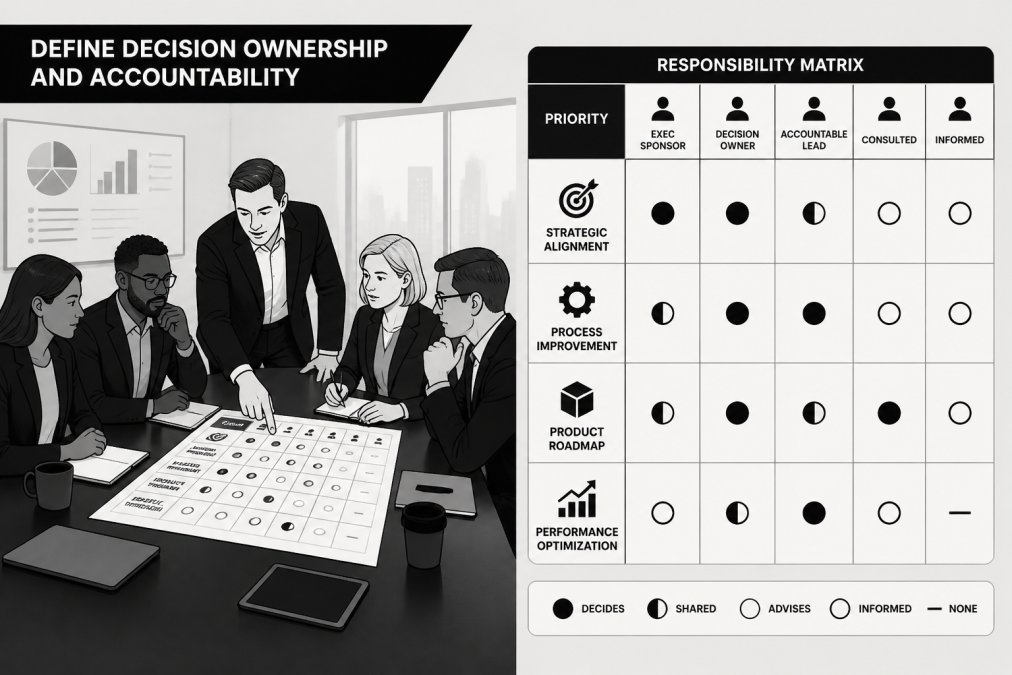
Every decision needs one owner with authority to decide and accountability for the outcome. Most organizations fail here: decisions get assigned to teams, which default to consensus, which requires everyone to agree and takes forever. Meanwhile, the priority stalls.
Here’s what works: Assign clear decision rights using a simple responsibility matrix. For each major decision, specify:
- Decision maker: Who has final say? This person decides if consensus doesn’t emerge.
- Input providers: Who must be consulted before the decision? Sales, finance, legal? List them.
- Informed parties: Who needs to know the outcome but doesn’t need input? Marketing, customer success?
- Executor: Who implements the decision once it’s made?
Write this down. Share it. Make it visible. When someone asks “who decides this,” the answer should be immediate.
The decision maker should be senior enough to override objections but close enough to the work to understand constraints. A VP of Product works; a CEO creates bottlenecks.
Design Your Decision-Making Meeting Agenda for Results
Most meetings about stalled priorities rehash the same ground with no decision emerging. Change the structure: make every decision meeting serve one purpose, move a specific priority forward.
Here’s the agenda that works:
State the decision (2 minutes). What exactly are we deciding today? Write it down. Make sure everyone sees the same question.
Review criteria and constraints (3 minutes). Remind people what matters and what’s off the table. This prevents debates that shouldn’t happen.
Present options (5-10 minutes). Show 2-3 realistic options. Not ten. Not one. Two or three options force a real choice.
Decide (5 minutes). The decision maker calls it. This is not a vote. This is not a discussion. The decision maker hears input, then decides.
Assign next steps (5 minutes). Who does what by when? Write it down. Assign owners. Set dates.
That’s thirty minutes maximum, one decision per meeting. The meeting works because it has boundaries: everyone knows the decision will be made, so people come prepared and move on.
How to Prioritize Competing Priorities Without Delay
When two priorities genuinely matter and you can’t fund both, use a scoring framework instead of intuition. Intuition feels fair but usually isn’t.
Score each priority on your decision criteria using a 1-5 scale, multiply by weight, and add them up. The highest total wins. This takes an hour, removes emotion, and helps people accept the outcome because they can see the math.
Example: You’re choosing between expanding into a new market or deepening your current market. Your criteria are: revenue potential (weight 3), execution speed (weight 2), and resource availability (weight 1).
New market scores: 4 on revenue, 2 on speed, 3 on resources. Total: (4×3) + (2×2) + (3×1) = 19.
Current market scores: 3 on revenue, 4 on speed, 5 on resources. Total: (3×3) + (4×2) + (5×1) = 22.
Current market wins. It’s not close. People accept it.
| Criteria | Weight | New Market Score | Current Market Score |
|---|---|---|---|
| Revenue Potential | 3 | 4 | 3 |
| Execution Speed | 2 | 2 | 4 |
| Resource Availability | 1 | 3 | 5 |
| Total | 19 | 22 |
Build an Escalation Path and Timeline for Stalled Strategy Execution
Even with clear ownership and accountability, decisions sometimes stall at execution. You need an escalation path tied to your responsibility matrix, your safety valve to keep momentum moving and ensure the right person intervenes.
Define what “stalled” means: a missed deadline, no status update for two weeks, or an unresolved blocker. Vague definitions lead to vague escalations.
Then map escalation to decision rights. Your responsibility matrix already names the decision maker, input providers, informed parties, and executor. Use those roles in your escalation path.
Here’s a concrete escalation sequence:
Day 1-7: Executor owns the task and can make small decisions without approval. Day 8-14: First check-in with direct manager.
Each escalation level should have clear authority to act. Write this escalation path down and make it visible in your project management tool or decision log.
Set hard deadlines for each phase. Don’t say “check in around day 10.” Say “status update due by 5 p.m. on Thursday, Day 10.” Hard deadlines create urgency. They also make it clear when escalation is triggered.
Escalation doesn’t mean blame. Frame it as “we need help removing this blocker,” not “you failed.” If the executor escalates early and often, that’s good. It means they’re unblocking themselves instead of sitting stuck.
This escalation path prevents tasks from sitting in limbo for months. It creates urgency. It also makes clear that stalling isn’t an option, and that help is available when the executor hits a real constraint.
Measure and Track Decision-Making Improvement
You can’t improve what you don’t measure. But measurement without diagnosis is just scorekeeping.
Start by tracking three core metrics:
Decision cycle time: How long from “we need to decide” to “decision made”? Measure this for your top 10 priorities. Your baseline might be 60 days. Your goal might be 14 days.
Action-item completion rate: What percentage of decisions actually get executed? If 80% of your decisions turn into action within 30 days, you have a strong execution culture. If it’s 40%, you have an accountability gap.
Decision reversal rate: How often do you revisit a decision you already made? One reversal per quarter is normal. One per month suggests your criteria weren’t clear or your decision maker lacked authority.
Review these metrics monthly. Share them with your leadership team. When you see improvement, celebrate it. When you see backsliding, diagnose why.
But here’s what most organizations miss: poor metrics don’t all point to the same problem. A long decision cycle time could mean priority conflicts (you’re debating which priority matters), unclear criteria (you can’t choose between options), or missing authority (the decision maker is stuck waiting for consensus).
Use this diagnostic framework to connect metrics to root causes:
| Metric | Poor Performance | Likely Root Cause | Diagnostic Question |
|---|---|---|---|
| Decision cycle time > 30 days | Priority conflict not resolved | Do we know which priority should win, or are we still debating it? | |
| Decision cycle time > 30 days | Unclear criteria | Can we rank our decision criteria and explain why we chose them? | |
| Decision cycle time > 30 days | Missing decision authority | Does the decision maker have the power to override objections and move forward? | |
| Action-item completion < 70% | Weak ownership | Is one person clearly accountable for each action, or is it a shared responsibility? | |
| Action-item completion < 70% | Unclear next steps | Do people know exactly what to do, who to ask for help, and when it’s due? | |
| Action-item completion < 70% | Resource constraints | Does the executor have the budget, headcount, or tools to actually do the work? | |
| Decision reversal rate > 1 per month | Criteria weren’t explicit | Were the decision criteria written down and weighted before the decision? | |
| Decision reversal rate > 1 per month | Decision maker lacked authority | Did the decision maker have the organizational standing to make this call stick? |
When you see a metric slip, run a quick diagnostic. Don’t just say “decision cycle time is up.” Ask: Is it up because we’re debating priorities, or because we lack criteria, or because the decision maker is bottlenecked? The answer tells you what to fix.
For example: If decision cycle time is 45 days but action-item completion is 85%, your problem isn’t accountability, it’s clarity on priorities or criteria. Fix the front end (decision-making), not the back end (execution).
If decision cycle time is 14 days but action-item completion is 50%, your problem isn’t decision-making, it’s ownership or resources. Fix the back end (execution), not the front end (decision-making).
Track these diagnostics in a simple decision log. For each major decision, record:
- The decision
- Decision cycle time (days from “need to decide” to “decided”)
- Decision criteria used (or note if criteria were unclear)
- Decision maker and their authority level
- Assigned owner for execution
- Action-item completion status at 30 days
- Any reversals or rework
Over time, this log shows you patterns. If most decisions get reversed, your criteria aren’t clear. If most decisions stall in execution, your ownership is weak. If most decisions take 60+ days, your decision makers lack authority or your priorities are genuinely in conflict.
This measurement does three things. First, it shows whether your decision-making process is actually improving. Second, it creates accountability. People change behavior when they know they’re being measured.
Frequently Asked Questions
How do you distinguish between a priority conflict and an accountability gap?
A priority conflict occurs when two legitimate objectives compete for the same resources or timeline, but no clear decision criteria exist to choose between them. An accountability gap happens when the decision authority is unclear, the owner lacks follow-through mechanisms, or stakeholders don’t know who is responsible for execution. Diagnose by asking: Is the problem unclear goals and trade-offs, or unclear ownership and follow-up? Priority conflicts need decision criteria and stakeholder input. Accountability gaps need a clear owner, a deadline, and a check-in schedule.
What should a decision-making meeting agenda include to actually move stalled priorities forward?
A focused decision-making meeting agenda should open with problem identification and the decision to be made, define decision criteria and constraints, present options with trade-offs, assign the decision owner and deadline, and end with a written action plan and next check-in date. Limit attendees to decision-makers and essential stakeholders. Avoid open-ended discussion; set a timer for each section. Document decisions in writing before the meeting ends. This structure prevents meetings from becoming status updates and ensures clarity on who decides and when.
How do you stop stalled strategy execution when multiple teams are involved?
Stalled strategy execution often stems from unclear decision rights across teams. Create a responsibility matrix that names the decision owner, identifies who must be consulted, who must approve, and who executes. Set a non-negotiable decision deadline and an escalation rule: if the owner hasn’t decided by that date, the decision escalates to their leader. Establish a weekly check-in rhythm for the first 30 days to track action-item completion and remove blockers. This combination of clarity, accountability, and visibility typically unblocks execution within two to four weeks.
What metrics indicate that decision-making has actually improved?
Measure decision-making improvement by tracking decision cycle time (days from problem identification to decision made), action-item completion rate (percentage of decisions followed by completed actions within the agreed timeline), and stakeholder alignment (survey whether team members know who owns each key decision). A healthy decision-making process shows cycle times under 10 business days, completion rates above 85%, and alignment scores above 80%. Improvement in these metrics, combined with reduced escalations and fewer re-opened decisions, signals that accountability and clarity have genuinely taken hold.
This article is part of my guide to better leadership decisions.


